Saudi Arabia mining investment due diligence starts with separating administrative momentum from project reality. In March 2026, Saudi Arabia issued 80 new mining licences, but the same source warns that licensing volumes can overstate outcomes because geological risk remains the primary variable and a licence is not a geological guarantee. Investors should therefore test the asset thesis early, then map the regulatory path and constraints that can compress returns. The Kingdom’s mining strategy prioritises gold, zinc, phosphate, and critical minerals for battery manufacturing and clean energy supply chains, drawing on an estimated $2.5 trillion in untapped geological reserves across the Arabian Shield. In 2025, the sector attracted SR44 billion (approximately $11.7 billion USD) in total investment, with exploitation licenses growing 220% year-on-year and exploration spending rising 110%.
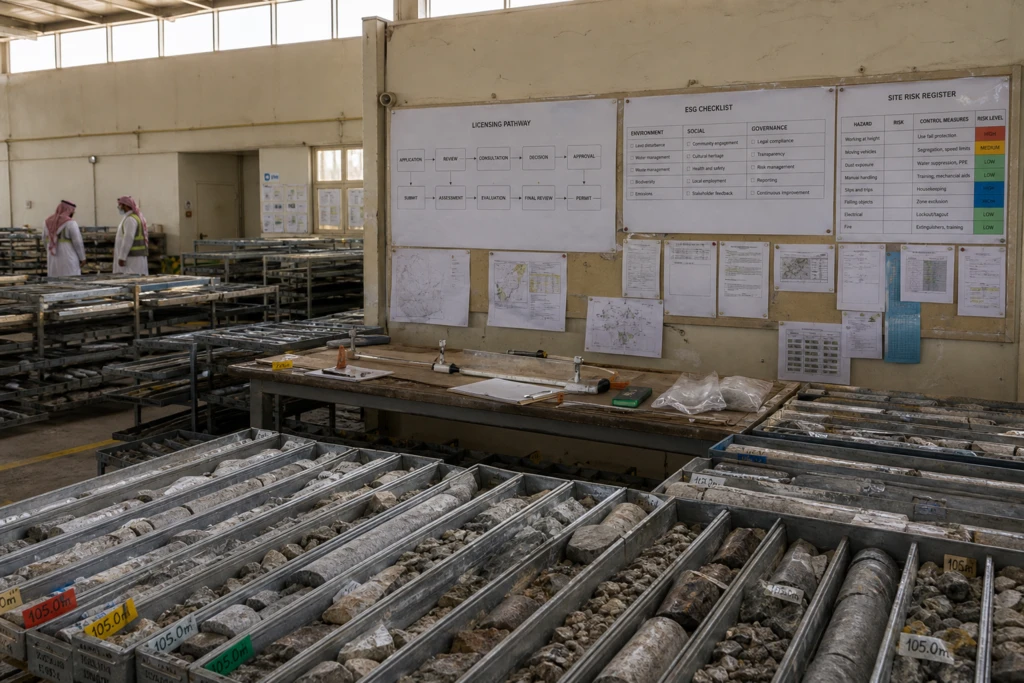
On the geology side, diligence should distinguish between extension targets along known belts and true greenfield exploration. One source stresses that extending a known productive belt has a different risk-reward profile than untested terrain, and points to operational evidence in the Sukhaybarat-Al-Safra belt where the Sukhaybarat and Bulghah mines already operate. It also highlights that two of three targeted belts already host operating mines, which matters when you are pricing risk and deciding how much data quality you need before you proceed. A concrete production anchor is cited in the Nabitah-Duwaihi belt: the Duwaihi mine produces approximately 180,000 ounces of gold per year. For investors, that type of baseline does not remove geological uncertainty, but it can change how you stage expenditure and what “proof” you demand at each gate.
Reading Licences, Process Design, and Execution Risk
Licensing diligence should focus on process design, eligibility, and how competitive pressure affects timelines and commitment strategy. Saudi Arabia’s Ministry of Industry and Mineral Resources administers exploration licences through a deliberately staged competitive framework intended to prioritise technical credibility and financial capacity over speculative participation. The same coverage notes a digital-first pre-qualification phase that can allow a company in Melbourne or Vancouver to assess blocks and competitive positioning without an expensive in-country presence. In 2026, 24 companies qualified for exploration licences, a reminder that your diligence should include competitor mapping, not just geology. Investors operating under ESG frameworks may also weigh transparency benefits from a digital-first approach when they assess jurisdictional risk.
ESG and operating-model diligence in Saudi Arabia is tightly linked to compliance and workforce structure. One source notes that ESG frameworks in the sector are still maturing relative to Australian or Canadian benchmarks, and that European institutional investors with strict ESG mandates should assess both current standards and the trajectory of regulatory development before committing capital. Workforce risk is not abstract: Saudization compliance creates structuring obligations because the national employment mandate requires mining operations to meet prescribed quotas for Saudi national employees across operational roles. That affects staffing models, training investment requirements, and operational cost structures. Pre-entry regulatory mapping is also flagged as essential to identify which minerals within a prospective licence area carry classification risk, so diligence should explicitly tie mineral type, licence terms, and compliance exposure together.
Finally, build your diligence plan like an investment, not a checkbox. A Saudi due diligence source estimates that comprehensive assessment typically costs 2–5% of transaction value, and frames it as a primary risk-mitigation tool to verify management claims, identify deal-breaking issues, quantify risks that need price adjustment or contractual protection, and shape post-acquisition value creation plans. A Saudi mining investment fund case study shows what institutionalisation can deliver: it reviewed over 60 potential mining investments and developed a scoring framework spanning financial KPIs, geological confidence, infrastructure readiness, ESG considerations, and regulatory feasibility. Reported outcomes included improved evaluation accuracy by 31%, decision-making speed up 28%, and due-diligence cycle times reduced by 22%, alongside identification of high-potential investments representing an estimated SAR 3.2 billion in strategic value creation.
What should Saudi Arabia mining investment due diligence cover first?
Which geology signals can reduce early-stage uncertainty in Saudi Arabia?
How do exploration licences get administered in Saudi Arabia?
What ESG and workforce issues should investors test before committing?
How much can comprehensive due diligence cost, and why do it?