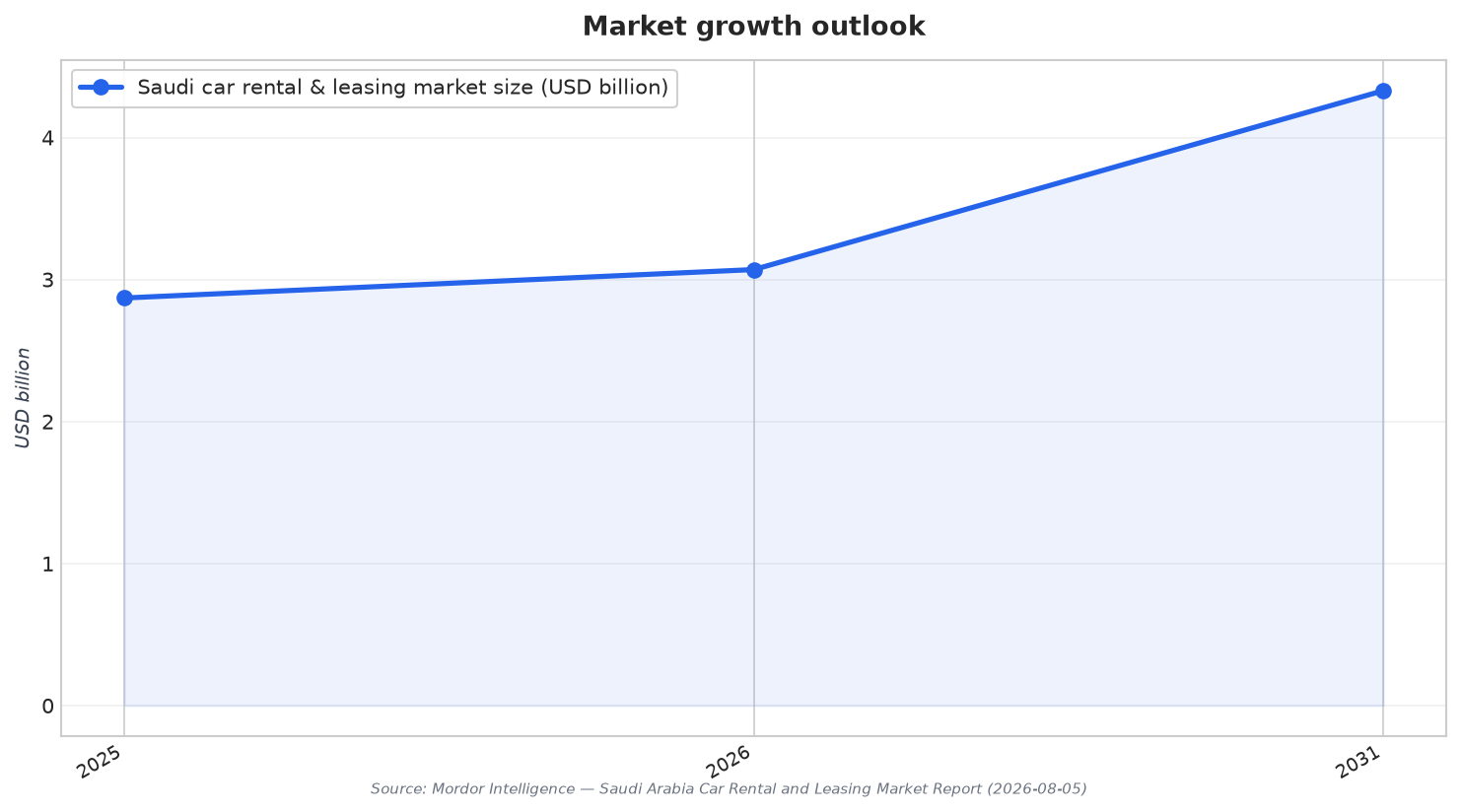
In Saudi Arabia, automotive demand is no longer only about buying a car. It is increasingly about accessing one when you need it. Mordor Intelligence estimates the Saudi Arabia car rental and leasing market at USD 3.07 billion in 2026, up from USD 2.87 billion in 2025, with a projection of USD 4.33 billion by 2031 and a 7.09% CAGR over 2026–2031. This sits alongside a much larger vehicle economy: Mordor Intelligence values the Saudi Arabia automobile market at USD 47.46 billion in 2025, estimating growth to USD 50.33 billion in 2026 and USD 67.55 billion by 2031 at a 6.05% CAGR. Together, these figures frame a demand mix that is broadening beyond traditional retail purchases.
“Own less, drive more” shows up clearly in how fleets are consumed. Corporate accounts captured 56.12% of revenue in 2025 in the car rental and leasing market, according to Mordor Intelligence, tying mobility demand to corporate outsourcing and cost optimization. Duration data points to a two-speed market. Short-term leasing held 50.68% share in 2025, but long-term leasing is expected to advance at a 7.22% CAGR through 2031. That combination matters for demand planning. Short-term volumes keep utilization high, while long-term contracts can lock in predictable fleet rotation and service schedules for employers, project teams, and business travel.
Digital Booking and Self-Drive Are Now the Default
Access-first mobility is also being pulled forward by digital behavior. Online channels captured 71.05% of the Saudi market share in 2025, with online reservations forecast to expand at a 7.21% CAGR to 2031, according to Mordor Intelligence. MarkWide Research adds that mobile app usage for bookings has reached 85% penetration among millennials and Gen Z customers. Usage patterns reinforce that customers want autonomy. Self-drive arrangements accounted for 76.98% share in 2025, while chauffeur-driven services are forecast to record a 7.15% CAGR over the same period. These trends reward operators that streamline pickup, return, and payment in-app, and they shift competition toward convenience and uptime.
What people drive is also being shaped by fleet economics. Economy and budget cars commanded a 62.85% share in 2025, showing how price-sensitive demand still anchors mainstream fleet sizing. Sedans accounted for 45.12% share in 2025, yet SUVs are projected to register a 7.36% CAGR through 2031, reflecting a strong appetite for higher-riding formats. The premium and luxury segment is also set for a faster growth profile, with Mordor Intelligence tracking a 7.34% CAGR between 2026 and 2031. IndexBox notes that ride-hailing and shared mobility services are reshaping fleet demand, with operators such as Careem and Uber expanding procurement and favoring fuel-efficient sedans and compact SUVs.
Tourism and mega-project activity add more reasons for fleets to expand and rotate quickly. MarkWide Research states that religious tourism accounts for 45% of rental demand, with Hajj and Umrah seasons creating significant seasonal peaks. Mordor Intelligence points to rising tourism and Vision 2030 infrastructure commitments as key demand supports, while also noting consolidation and technology-led differentiation among operators. On the broader market side, IndexBox reports that Saudi Arabia has annual new vehicle sales exceeding 1 million units since 2022, and that personal/private transportation accounts for 65–70% of demand, with commercial fleet and logistics at 20–25%. As subscription and fleet models mature, demand signals increasingly come from platforms, employers, and operators—not just individual buyers.
How big is Saudi Arabia’s car rental and leasing market in 2026?
What share of revenue comes from corporate customers?
Are Saudis booking rentals online or offline?
What does the Saudi Arabia car leasing market data say about short-term vs long-term demand?
Which vehicle types dominate fleet demand in rentals and leasing?