Saudi heat-resilient infrastructure is increasingly framed as a full urban operating model, especially where tourism, healthcare, and large venues must function in one of the hottest climates on earth. Cooling is described as a critical enabler for tourism growth and a major source of energy demand, so it is no longer treated as an afterthought. The practical question for cities is how to keep hotels, malls, airports, hospitals, and entertainment venues comfortable and reliable when outdoor conditions routinely undermine daytime activity and raise operating risk. That pushes city planning to combine equipment choices, public-space design, and operational governance.
A visible adaptation pathway is to shift demand toward naturally cooler zones. Abha’s emerald mountains and bracing winds contrast with the stereotypical image of Saudi sands and searing heat, and the city has become a domestic summer escape for people looking to “touch the clouds” above Jabal Soudah, described as nearly 9,900 feet. Public spaces such as Art Street and parks like Al Sahab have been developed with theaters, festivals, cafes, and viewpoints, while traditional markets like Souq Al Thulatha still sell regional specialties. This mix matters because it links urban comfort to walkable, shaded, and programmed outdoor areas rather than relying only on enclosed, air-conditioned interiors.
Cooling, Scheduling, and Governance Become City Systems
On the engineering side, Saudi Arabia is also adapting by localizing cooling capacity. A new factory in Jeddah is positioned within a policy pivot to localize production of core HVAC components, reduce imports, and support industrial jobs, while also designing for efficiency to limit the power and emissions footprint of tourism infrastructure. Shorter supply chains also help mega-projects respond quickly to design changes or new regulations on energy use and refrigerants. Practically, chillers and hydronic heat pumps can be tuned for the Gulf’s extreme heat and humidity, and factory-level testing can reduce costly delays that otherwise appear only after installation.
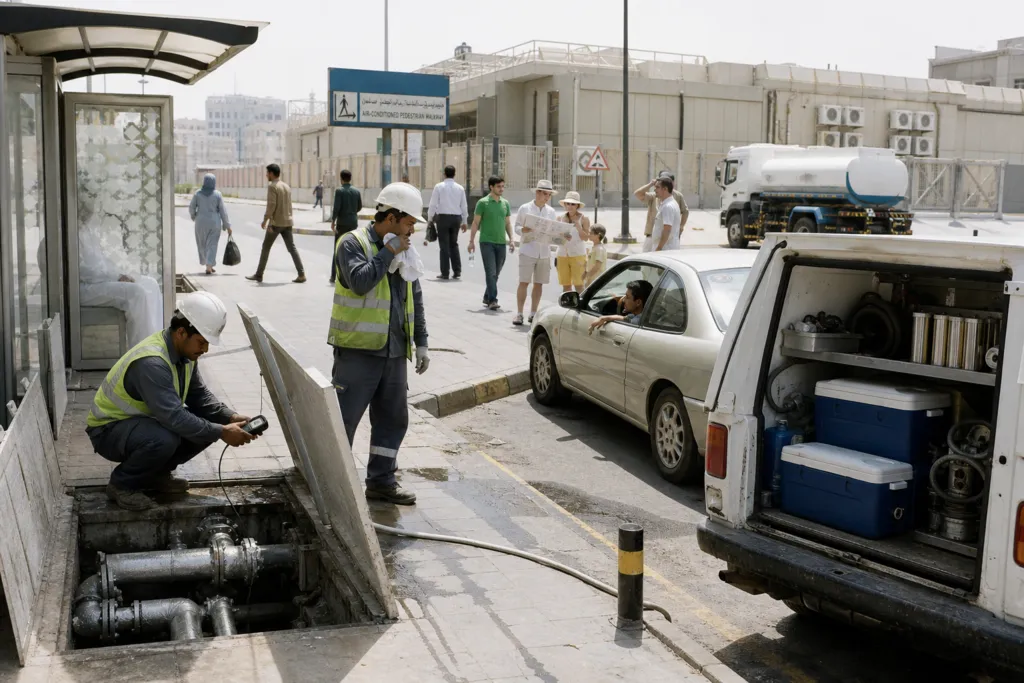
Operations are being redesigned around heat as a constraint, not a public-relations issue. One industry view warns that extreme summer heat can make 4–5 months effectively unmarketable for outdoor use, forcing assets to generate their year’s yield in just 7–8 months, while operating costs soar and event risk grows. That same view points to governance tactics such as “Heat Index Playbooks” that set thresholds for event timings, ticket refunds, worker rosters, and cooling stations, automated by live climate data. It also notes that mandatory midday work bans across June to September shrink construction and operations windows, increasing scheduling complexity and cost pressure.
Beyond cooling, heat resilience intersects with water reliability. Saudi Arabia meets 70 percent of its water needs through desalination, operating 32 plants across 17 locations, according to the World Population Review as cited by Arab News. National water demand is expected to reach nearly 18 million cubic meters per day by 2030, driven by population growth and economic expansion under Vision 2030. At the facility level, a managing director quoted by Arab News said clients across sectors including healthcare, hospitality, agricultural sites, and remote accommodation are becoming more attentive to operational resilience in water treatment systems, with interest in redundant components, backup disinfection, and modular system configurations.
Urban form and public-space design also influence how cities cope with heat. A Scientific Reports-linked review highlighted four high-scoring adaptation measures across continents: increasing pervious-surface fraction, expanding vegetation cover and green spaces, enhancing water bodies, and using reflective building materials. Separately, examples from other hot cities show the logic of building “cool networks,” such as Paris creating an app pointing to 800 “cool islands” linked by cooler walkways. The transferable lesson is that Saudi heat-resilient infrastructure can pair industrial-scale cooling and water redundancy with shade-first, walkable, and governable city systems—so daily life works even when heat reshapes schedules and public behavior.
What does “Saudi heat-resilient infrastructure” mean in practice?
Why is localized HVAC manufacturing relevant to heat resilience?
How does Saudi Arabia support water resilience under extreme conditions?
How does tourism planning adapt to extreme summer heat?
Which city-design measures are commonly recommended for heat adaptation?